Tree pests can weaken or kill trees, disrupt landscapes, and create safety hazards. In Michigan, pests like the Emerald Ash Borer, Spongy Moth caterpillar, and Hemlock Woolly Adelgid threaten tree health. Preventing damage involves regular inspections, pruning, and using physical barriers or natural pest control methods. For recovery, prune damaged branches, clean debris, and ensure proper watering and fertilization. When pest damage is severe, consult certified arborists to assess tree health and apply targeted treatments. Acting quickly minimizes risks, saves trees, and protects property value.
Cultivating Healthy Plants – Tree Pests: What to Manage, What to Ignore, What’s Impossible to Fix
sbb-itb-a61c528
Common Tree Pests and Their Damage
Common Michigan Tree Pests: Identification Guide and Damage Types
Most Common Pests in Michigan
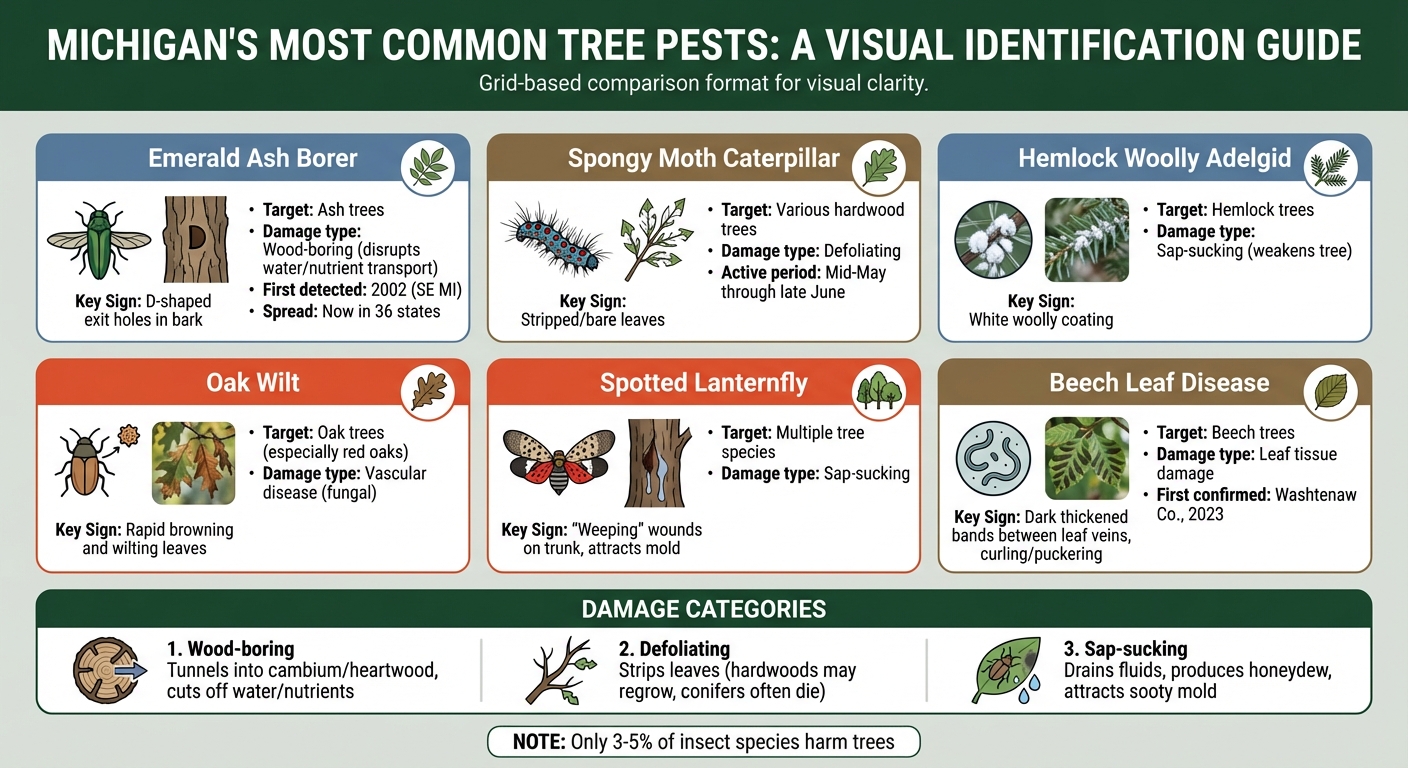
Michigan’s trees face challenges from both invasive and native pests, each capable of causing severe damage. One of the most destructive is the Emerald Ash Borer, a metallic green beetle first spotted in southeastern Michigan in 2002, which has since spread to 36 states. This pest leaves distinctive D-shaped exit holes in ash tree bark, while its larvae tunnel beneath, disrupting the tree’s ability to transport water and nutrients.
The Spongy Moth caterpillar is another major problem. Recognizable by its blue and red spots paired with long, dark hairs, this pest feeds on tree leaves from mid-May through late June, often stripping trees bare. Hemlock Woolly Adelgid, on the other hand, targets hemlock trees, forming white, cotton-like masses on branches as it feeds on sap, ultimately weakening the tree.
Oak trees are not spared either. Oak Wilt, a fungal disease spread by sap-feeding beetles, causes leaves to brown and wilt rapidly, with red oaks being especially susceptible. Adding to the threat is the Spotted Lanternfly, which creates "weeping" wounds on trunks that attract other pests and encourage mold growth. Meanwhile, Beech Leaf Disease, confirmed in Washtenaw County in 2023, is spreading across Southeast Michigan. Caused by microscopic nematodes, this disease results in dark, thickened bands between leaf veins, along with curling and puckering of leaves.
Each of these pests has unique characteristics, but they all contribute to the declining health of Michigan’s trees.
How Pests Harm Trees
Tree pests use various methods to weaken or kill their hosts. Wood-boring insects like the Emerald Ash Borer and Asian Longhorned Beetle tunnel into the cambium or heartwood, cutting off the tree’s water and nutrient flow. Meanwhile, defoliating pests such as the Spongy Moth strip trees of their leaves. While hardwoods can sometimes regrow leaves by late summer, conifers like pine and spruce lack this ability and may die after severe defoliation.
Sap-sucking insects – including aphids, scale insects, and the Spotted Lanternfly – drain essential fluids from tree tissues, leaving trees weakened and more prone to secondary infections. These pests also produce a sticky substance called honeydew, which attracts other insects and promotes the growth of sooty mold, further hindering photosynthesis. Additionally, some pests act as carriers for diseases. For example, the Banded Elm Bark Beetle, first detected in Michigan in 2004, spreads the fungus responsible for Dutch elm disease.
How to Prevent Tree Pest Damage
Physical Prevention Methods
One way to tackle tree pests without relying on chemicals is to physically remove them. For larger pests like caterpillars, grasshoppers, or bagworms, simply handpick them and drop them into soapy water to reduce their numbers. Regular pruning also plays a big role – trimming away dead or diseased branches not only removes potential pest entry points but also improves airflow and light, making trees less inviting to fungi.
Adding physical barriers can further protect your trees. Sticky bands wrapped around trunks can trap crawling insects before they climb up, and netting or cages can shield young trees from bigger pests. A layer of organic mulch (2 to 3 inches thick) around the base of the tree helps retain moisture and suppress weeds that might harbor pests. Just make sure the mulch doesn’t touch the trunk to avoid rot.
When pruning larger branches, use the 1-2-3 method to avoid damaging the bark: start with an undercut 12–18 inches from the trunk, follow with a top cut further out, and finish with a clean cut just outside the branch collar. Sterilize pruning tools with alcohol or bleach between cuts to prevent spreading diseases. Make it a habit to inspect your trees monthly, checking under leaves and along the bark for signs of trouble like holes, sticky residue, or visible insects.
Pair these physical methods with natural solutions to create a healthier tree environment.
Natural Pest Control Options
Natural pest control works by encouraging a balanced ecosystem around your trees. Interestingly, only about 3%–5% of insect species are harmful to trees; the rest are neutral or even helpful. Planting flower gardens or leaving parts of your yard unmowed creates habitats for natural predators like lady beetles, lacewings, and spiders, which can help keep pests in check.
"If you kill the natural enemy of a pest, you inherit their job." – Steve Renquist, Extension Agent, Oregon State University
For targeted pest control, organic products can be effective. Bacillus thuringiensis (Bt) targets specific caterpillars, while Spinosad works well against insect larvae. Both are derived from bacteria and are safe for mammals [18, 19]. A strong spray of water can knock off soft-bodied pests like aphids and mites [19, 20, 21]. Horticultural oils and insecticidal soaps are also useful for managing pests like aphids, whiteflies, and scale insects during their vulnerable crawler stage, and they don’t leave harmful residues once dry [10, 19].
Be cautious with fertilization – too much nitrogen can lead to rapid, lush growth that attracts pests like aphids. If you notice sticky honeydew on leaves, it’s often a sign of aphids or soft scale insects. Don’t forget to check for ants, as they often "farm" these pests for the honeydew they produce.
Chemical Treatments and Professional Help
Chemical treatments should only be considered when the extent of pest damage justifies the cost and effort. For invasive pests like the Emerald Ash Borer or Asian Longhorned Beetle, insecticides might be necessary since these pests can kill even healthy trees.
Timing is everything with chemical treatments. Instead of relying on calendar dates, applications are best scheduled based on Growing Degree Days (GDD), which use 50°F as a base temperature. For instance, eastern tent caterpillars are most effectively treated between 90 and 190 GDD. Professionals often use plant bloom cycles as natural indicators – when lilacs bloom, pine needle scale eggs hatch, and when black locusts flower, bronze birch borers emerge. This precise timing highlights the value of hiring certified professionals for pest control.
"If you apply treatment products too early, the pest or pathogen you’re trying to address probably hasn’t yet appeared. If you apply it too late, you’ll miss the window of opportunity during which the treatment will be effective." – Alpine Tree Service
Certified arborists can correctly identify pests and recommend the most effective treatments, saving you time and money. They’re also licensed to apply pesticides and understand the differences between systemic insecticides, which can protect trees for up to two weeks, and contact insecticides that only target pests present at the time of application [10, 25]. When using contact insecticides, professionals often apply them at dusk to protect pollinators like bees.
How to Recover Pest-Damaged Trees
Pruning Damaged Branches and Cleanup
Start by identifying and removing dead, broken, or diseased branches that could spread pests. You can use a simple scratch test: gently scratch the bark – green tissue underneath means the branch is alive, while brown or dry tissue indicates it’s dying.
For branches thicker than 1.5 inches, use the three-cut method:
- Make the first cut underneath the branch, 6–12 inches from the trunk.
- Follow with a top cut further out to reduce the branch’s weight.
- Finish with a clean cut just outside the branch collar to protect the tree’s natural healing process.
Avoid flush cuts against the trunk, as they interfere with the tree’s ability to seal wounds.
"Trees do not heal in the true sense of the word… Trees react by closing the wound and compartmentalizing or isolating the injured tissue."
- Everett Janne, Extension Landscape Horticulturist
Always disinfect your tools between cuts using a solution of one part bleach to nine parts water or rubbing alcohol. This prevents spreading diseases from infected branches to healthy ones. Skip wound dressings or pruning paints – they don’t help and may even slow the sealing process. Also, limit pruning to no more than 20%–30% of the tree’s canopy in a single year to avoid stressing it further.
Once pruning is done, clean up all debris, including branches and leaves. These can harbor pests or their larvae. You can chip the wood for mulch or dispose of it according to local guidelines to prevent lingering pathogens. Afterward, consider scheduling a professional tree assessment to address any structural concerns.
Getting a Professional Tree Assessment
After clearing debris, consult a certified arborist if you notice signs like exit holes in bark, frass (sawdust-like waste), early leaf drop, or thinning canopies. Structural issues like leaning, vertical cracks, peeling bark, or fungi near the base also warrant a professional’s attention. If the tree is near power lines, buildings, or public spaces, an immediate assessment is even more crucial for safety.
Pruning is just the first step. A certified arborist can evaluate the tree’s overall health and viability. They use tools like resistographs to measure internal decay and pinpoint specific pests and their life cycles. The arborist will also classify the tree’s risk level – low, moderate, high, or extreme – so you can plan your next steps. Generally, a tree can recover if it loses up to 50% of its branches, provided the trunk is intact. However, if more than one-third of the bark is missing around the trunk, survival is unlikely.
"A tree can lose half its branches and recover beautifully, but serious trunk injuries usually mean we’re looking at removal for safety reasons."
- DJ Waters, Branch Manager and ISA Certified Arborist, Arbor Masters
Make sure your arborist is certified by the International Society of Arboriculture (ISA) to ensure they meet professional standards. Schedule assessments in spring, when pest activity is more noticeable, or in winter, when it’s easier to spot structural issues without foliage.
Ongoing Care for Tree Recovery
After pruning and assessment, focus on long-term care to help your tree regain strength. Water deeply and slowly – a gentle trickle allows moisture to reach the roots without washing away vital nutrients. Add 2–4 inches of organic mulch, like wood chips or bark, around the base to retain soil moisture and regulate temperature. Be sure to keep the mulch away from the trunk to prevent rot.
Support recovery with slow-release fertilizers or organic compost, but avoid high-nitrogen fertilizers that encourage excessive leaf growth at the expense of overall health. Trees heal by "compartmentalizing" wounds, growing new tissue to seal off damaged areas rather than regenerating like animals. Faster wound closure means fewer long-term issues.
"Faster wound closure results in fewer health issues for the tree. Quick healing is always better!"
- Lindsey Purcell, Chapter Executive Director, Indiana Arborist Association
Check your tree monthly for signs of pests. Look under leaves, along the bark, and around the base for holes, sticky residue, or visible insects. Wounds can attract pests because exposed tissue releases phytochemicals. If you see rapid health decline, signs of vascular disease, or a recurring infestation, contact a professional immediately.
When to Call Viking Tree & Stump
When pest damage makes recovery unsafe or creates an immediate hazard, it’s time to bring in the professionals.
Viking Tree & Stump Services
Viking Tree & Stump tackles pest-related tree issues throughout Oakland and Macomb counties. Their certified arborists specialize in tree trimming and pruning to remove compromised branches, tree removal for cases where recovery isn’t possible, and stump grinding to eliminate pest-friendly environments. They also offer 24/7 emergency storm response for trees weakened by pests during severe weather.
The team is skilled at identifying pests like the Emerald Ash Borer and Spotted Lanternfly, using targeted treatments to protect healthy trees. For property owners in Bloomfield Hills, Troy, Royal Oak, Birmingham, and nearby areas, Viking Tree & Stump provides free estimates. They use advanced equipment tailored to the challenges of urban and suburban settings.
Why Use Professional Tree Care
Handling pest-damaged trees on your own can be risky. Each year, over 50 fatalities occur during tree pruning or removal, underscoring the dangers for both homeowners and professionals. Pest-weakened branches often have hidden pressure points, leading to unpredictable and potentially dangerous reactions when cut.
"The best way is to call a professional. It’s really difficult to identify how much of a hazard that branch could be. Sometimes, there are areas of pressure on a branch that you may not be aware of, and if a homeowner were to just go and take a chainsaw and start to cut it, the reaction to that cut may be pretty devastating."
- J Zambo, Lawn & Tree Division Manager, ABC Home & Commercial Services
Certified arborists provide essential expertise in these situations. They can distinguish between minor cosmetic damage and pests that threaten the tree’s survival. Using proper techniques like the three-cut method, professionals help trees heal and prevent further decay. This level of care is especially important for mature trees on luxury estates or in historic areas, where maintaining both safety and appearance requires a high level of skill.
Service Areas and How to Contact
Viking Tree & Stump serves residential and commercial clients across Oakland County, including Bloomfield Hills, Troy, Royal Oak, Birmingham, Farmington Hills, and Novi, as well as Macomb County areas like Rochester Hills, Clinton Township, Shelby Township, and Franklin. Be on the lookout for signs of pest infestation such as exit holes in the bark, frass on the ground, chewed leaves, sparse or discolored foliage, or structural issues like cracked bark or sudden leaning. If a tree is touching a power line, stay away and call 911 immediately.
To schedule a consultation, consider booking in August for pest inspections or immediately after severe weather if you notice hazardous limb damage. Visit https://vikingtreeandstump.com to arrange a professional assessment and safeguard your property from pest-related tree damage.
Conclusion
Spotting pest problems early and keeping up with routine care can save your trees from serious damage. Regular inspections and maintenance – like proper watering, fertilizing, and clearing debris – help trees stay strong and naturally resist pests better than those under stress.
Taking quick action can mean the difference between saving a tree and losing it. Catching an infestation early allows for targeted treatments that disrupt the pest’s life cycle before it spreads to other trees. Professional arborists have access to advanced treatments that not only aid recovery but also provide protection for up to two years. These solutions go beyond what store-bought products can achieve.
Delaying treatment doesn’t just harm your trees – it can also lead to higher repair costs and safety hazards. For instance, in Britain, the ash dieback crisis is expected to cost £15 billion over a century, with half of that expense occurring in just the first decade. Weak trees can become dangerous, with branches breaking unexpectedly, and untreated infestations can quickly spread to healthy trees. As Cecilia A L Dahlsjö from the University of Oxford wisely put it:
Prevention is better than cure.
To avoid these risks and protect your investment, homeowners in Oakland and Macomb counties can turn to Viking Tree & Stump. Their certified arborists have the expertise needed to keep your trees healthy and thriving. Visit https://vikingtreeandstump.com to schedule a professional assessment today.
FAQs
How do I know which pest is attacking my tree?
To figure out what pest is troubling your tree, pay attention to specific signs. For example, sticky residue (known as honeydew), curled or yellowing leaves, brown spots, or dead branches can all point to an issue. If you notice tiny holes or sawdust on the bark, it might mean wood-boring insects are at work. Regular inspections are key – keep an eye out for these symptoms to identify the pest and decide on the next steps. If you’re unsure, reaching out to a certified arborist can provide expert guidance on identifying and treating the problem.
Can a badly infested tree still be saved?
Yes, a tree with a severe infestation can sometimes be saved, provided it is still healthy overall, structurally stable, and its main limbs are intact. With the right care and timely intervention, recovery is possible. Seeking advice from a certified arborist can help evaluate the tree’s condition and identify the most effective steps to restore its health.
When should I call an ISA Certified Arborist?
If you need to assess tree damage, check a tree’s health, or address issues caused by construction, reaching out to an ISA Certified Arborist is the way to go. These professionals have the expertise to provide proper care and ensure safety, whether you’re looking to help a tree recover or prevent future problems. They can guide you in restoring your trees’ health while reducing potential risks down the line.