Finding the right arborist in Michigan is essential for proper tree care and protecting your property. Here’s how to make an informed choice:
- Verify Credentials: Look for ISA Certified Arborists. Use TreesAreGood.org to confirm their certification and check for additional qualifications like TRAQ (Tree Risk Assessment Qualification) or a State Pesticide Applicator License.
- Check Insurance: Always request proof of liability insurance and workers’ compensation coverage to avoid potential liabilities.
- Ask Questions: Inquire about their experience, services offered, and adherence to ANSI standards. Avoid those using harmful techniques like climbing spikes on trees meant to remain.
- Check References: Request local references and read online reviews to assess their track record.
- Compare Estimates: Get detailed written estimates from multiple arborists to understand pricing and services included.
Hiring a certified arborist ensures your trees receive professional care while minimizing risks to your property and safety.
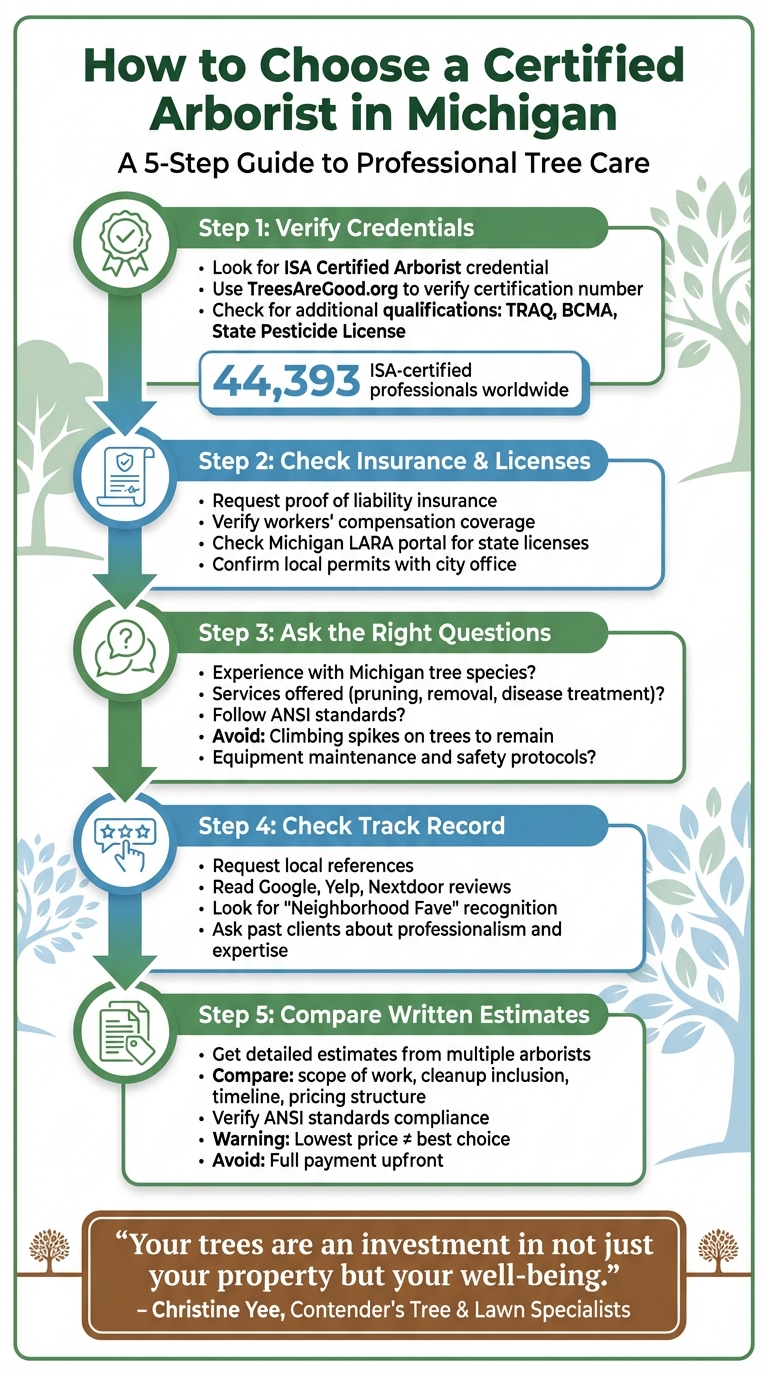
5-Step Process to Choose a Certified Arborist in Michigan
Tips on Choosing a Certified Arborist
sbb-itb-a61c528
What Arborist Certifications and Credentials Mean
Tree care professionals come with varying levels of training, and certifications are a way to confirm their expertise. These credentials ensure that an arborist has undergone testing and stays updated through continued education. Knowing what these certifications represent can help you choose someone qualified, rather than someone with insufficient training.
ISA Certification Explained
The ISA Certified Arborist credential is widely recognized as the standard for professional tree care. Offered by the International Society of Arboriculture (ISA), this certification requires candidates to meet specific qualifications. They must have at least three years of full-time experience in arboriculture or hold a related degree – like forestry or horticulture – combined with relevant hands-on experience. On top of that, they must pass a detailed exam that covers topics like tree biology, diagnosis, maintenance techniques, and safety standards. Currently, there are 44,393 ISA-certified professionals worldwide. In Michigan, for example, the Arboriculture Society of Michigan (ASM) serves as a hub for connecting certified experts. Hiring an ISA Certified Arborist means you’re choosing someone trained in science-backed tree care who stays current with the latest industry practices. Additional certifications can further demonstrate their specialized skills.
The ISA also offers different levels of certification. For general tree care, an ISA Certified Arborist is a great choice. However, for more advanced needs – like complex diagnoses or high-level consulting – you might want to hire a Board Certified Master Arborist (BCMA). This is the ISA’s top-tier certification, requiring extensive experience and passing a challenging exam focused on advanced science and management.
Additional Credentials Worth Checking
Beyond the basic ISA certification, there are specialized credentials that highlight expertise in specific areas. For example:
- The Tree Risk Assessment Qualification (TRAQ) is designed for arborists trained to assess tree hazards. If you’re worried about falling branches or unstable trees, this qualification is particularly important.
- For work near power lines, look for someone with the ISA Certified Arborist Utility Specialist credential, which confirms their knowledge of electrical clearance and safety requirements.
- The Certified Treecare Safety Professional (CTSP), offered by the Tree Care Industry Association, demonstrates a focus on crew safety and adherence to proper protocols.
- If pest or disease treatments are involved, your arborist should also hold a State Pesticide Applicator License to ensure they’re authorized to apply treatments safely and effectively.
These certifications not only validate an arborist’s expertise but also ensure they’re prepared to handle specific challenges safely and professionally.
How to Verify an Arborist’s Qualifications
Knowing which certifications are important is just the first step. The next is confirming that the arborist you’re considering truly holds those credentials. Here’s how to make sure you’re hiring someone with verified qualifications.
Confirming Certification and Professional Memberships
Start by asking for the arborist’s ISA certification number (e.g., MI-1234A). Then, head over to the "Find an Arborist" section on TreesAreGood.org to verify it.
"The best way to verify this credential number is to search on the ISA Certified Arborist® database. Simply go to treesaregood.org, click the ‘Find an Arborist’ section then choose ‘Verify a Credential.’ From there, enter the credential certification number and submit the request to see if the credential is genuine."
- Lindsey Rice, Office Manager, Russell Tree Experts
You can also request a business card that includes the ISA Certified Arborist® logo and the certification number. If they are part of additional organizations like the Tree Care Industry Association (TCIA) or the American Society of Consulting Arborists (ASCA), it’s another good indicator of their expertise. In Michigan, the Arboriculture Society of Michigan (ASM), the local ISA chapter, can be a helpful resource for finding professionals who are active in the state arborist community.
Checking Michigan Licenses and Permits
Certifications aside, it’s important to check if the arborist complies with local licensing and permit requirements.
While Michigan doesn’t mandate a specific "arborist license", certain tree service activities might require state-level professional licenses or local permits. You can verify licenses through the Michigan Department of Licensing and Regulatory Affairs (LARA) online portal. This tool provides details like the licensee’s status, issue and expiration dates, and any disciplinary actions.
"You can also use our free online licensee search to verify someone is licensed in Michigan. It is a simple way to verify a licensee, issue date, and expiration date of a license, as well as any disciplinary action."
- Michigan Department of Licensing and Regulatory Affairs (LARA)
Additionally, check with your local city office to see if specific permits or contractor licenses are necessary. Don’t forget to ask for proof of liability insurance and workers’ compensation coverage to ensure you’re protected.
What to Ask Before Hiring an Arborist
Once you’ve confirmed their credentials and licenses, it’s time to dig deeper with specific questions. These will help you gauge their expertise, ensure safety, and protect your investment – especially with Michigan’s unique tree care requirements and challenges.
Questions About Experience and Services
Start by asking about their experience and the tree care services they specialize in. Services can range from planting and pruning to diagnosing diseases, pest management, removal, and stump grinding. Keep in mind, not all certified arborists handle every service. For instance, some arborists in Michigan may focus solely on plant health care and skip trimming or pruning altogether.
Ask for local references to verify their familiarity with Michigan’s tree species and the pests common to the area. It’s also worth checking if they follow the American National Standards Institute (ANSI) guidelines for tree care operations.
Another critical question: Do they use climbing spikes on trees that will remain? This can harm the tree’s health, so it’s essential to clarify. Additionally, discuss the project logistics upfront – who’s responsible for cleanup, whether stump removal is included, the timeline, and if the estimate covers everything or is based on hourly charges.
Finally, make sure their safety practices and insurance policies align with your expectations.
Questions About Safety and Insurance
Safety is non-negotiable. Always request written proof of liability insurance and workers’ compensation coverage. Ask for a certificate of insurance (COI) detailing the arborist’s coverage.
"You can be sued if an uninsured tree worker hurts himself on your property, even if they tell you they are insured."
- Christine Yee, Contender’s Tree & Lawn Specialists
Confirm they maintain their equipment regularly and follow strict safety protocols. If your home was built before 1978, check whether the contractor has EPA RRP (Renovation, Repair, and Painting) Certification, as this is required for work on structures that might contain lead paint. Before signing any contract, make sure you have written proof of their insurance and bonding policies.
How to Check an Arborist’s Track Record
Getting References and Reading Reviews
Once you’ve verified an arborist’s credentials and asked the important questions, it’s time to dig into their track record. Start by asking the arborist for references – this allows you to speak directly with past clients and hear firsthand about their experiences. When you reach out, inquire about the arborist’s technical expertise, professionalism, and how well they cared for the property during the job.
"Tree care is a long-term commitment and investment so ask referrals plenty of questions to ensure you are comfortable with the tree contractor’s knowledge."
- Christine Yee, Contender’s Tree & Lawn Specialists
In addition to personal references, explore online review platforms like Google and Yelp. These sites offer unfiltered insights into customer satisfaction from others in Michigan who’ve worked with the arborist. Neighborhood-specific platforms, such as Nextdoor, are also worth checking out. Some arborists even earn "Neighborhood Fave" recognition based on local community votes. While testimonials on the arborist’s website can be helpful, remember that independent reviews often provide a more balanced perspective.
After gathering feedback, you’ll be in a better position to compare services and make an informed decision.
Comparing Written Estimates
Request detailed written estimates from several arborists in your area to evaluate both pricing and service quality. This step ensures you understand the scope of work and can identify any major differences in what each arborist is offering.
"Pricing can vary significantly from one arborist to another as does the level experience and quality of work provided. But remember, the lowest estimate does not necessarily mean you should choose that arborist."
- Christine Yee, Contender’s Tree & Lawn Specialists
A thorough estimate should outline key details like the specific work to be performed (e.g., pruning methods or tree removal), whether cleanup and debris removal are included, and if stump grinding is part of the job. It should also specify a clear timeline with start and completion dates. Find out if the price is fixed or if additional tasks will be billed hourly. Payment terms should also be clarified upfront – avoid companies that demand full payment before any work begins.
Additionally, confirm that the work will follow ANSI standards for tree care. If you’re planning tree work during Michigan’s colder months, ask if the company offers off-season discounts. Many reputable arborists provide reduced rates during slower periods to keep their schedules full.
Conclusion
Finding the right certified arborist in Michigan becomes simpler when you focus on verifying credentials, experience, and reputation. This ensures the health of your trees and the safety of your property.
Start by checking credentials through TreesAreGood.org or the MDARD directory. Confirm that the arborist has liability insurance and workers’ compensation coverage. Tree care is inherently risky, requiring specialized training and adherence to ANSI standards.
"Your trees are an investment in not just your property but your well-being."
- Christine Yee, Contender’s Tree & Lawn Specialists
To protect your investment, watch for warning signs like the use of climbing spikes on trees that aren’t being removed. Ask for multiple written estimates and check references to ensure you’re making an informed choice. Avoid basing your decision solely on price – expert tree care relies on skill, proper tools, and adequate insurance. By following these steps, you can ensure your trees receive the professional attention they need.
FAQs
What qualifications and certifications should a professional arborist have?
When selecting a professional arborist, prioritize those with an ISA Certified Arborist designation. This certification demonstrates that they’ve successfully completed a challenging exam that covers essential areas like tree biology, care techniques, diagnosis, and safety practices. It’s a strong sign of their knowledge and dedication to maintaining high standards in tree care.
To confirm their credentials, ask for proof of certification or verify their status through the International Society of Arboriculture (ISA) directory. Beyond certification, take a close look at their experience, professional memberships, and customer reviews to ensure they’re reliable and well-qualified to handle your tree care needs.
How do I check if an arborist in Michigan is licensed and insured?
To confirm that an arborist in Michigan is properly licensed and insured, start by checking their credentials with the Michigan Department of Licensing and Regulatory Affairs (LARA). This ensures they meet state requirements and adhere to local regulations. You can also ask the arborist directly to provide proof of their license.
Additionally, make sure the arborist carries liability insurance and workers’ compensation insurance. These protect you from potential property damage or injuries that could occur during the job. Most reputable arborists will gladly share this documentation when asked. For added reassurance, see if they’re certified by organizations like the International Society of Arboriculture (ISA). ISA-certified arborists are held to high standards of safety and professionalism, giving you confidence in their qualifications and reliability for your tree care needs.
Why should I get quotes from multiple certified arborists?
Getting quotes from several certified arborists is a smart way to ensure you’re getting a fair price for quality tree care. Costs can differ depending on the arborist’s experience, certifications, and the specific work they propose. By comparing estimates, you can identify bids that seem unusually high or low and make a more informed choice.
This approach also lets you assess each arborist’s professionalism. Pay attention to detailed and clear proposals that explain their services and methods. Doing so helps you select a skilled expert who can handle your tree care needs safely and effectively, all while offering a competitive rate.