Tree care mistakes can damage your property, lower home value, and even kill your trees. Here’s a quick guide to avoid these pitfalls and keep your trees healthy:
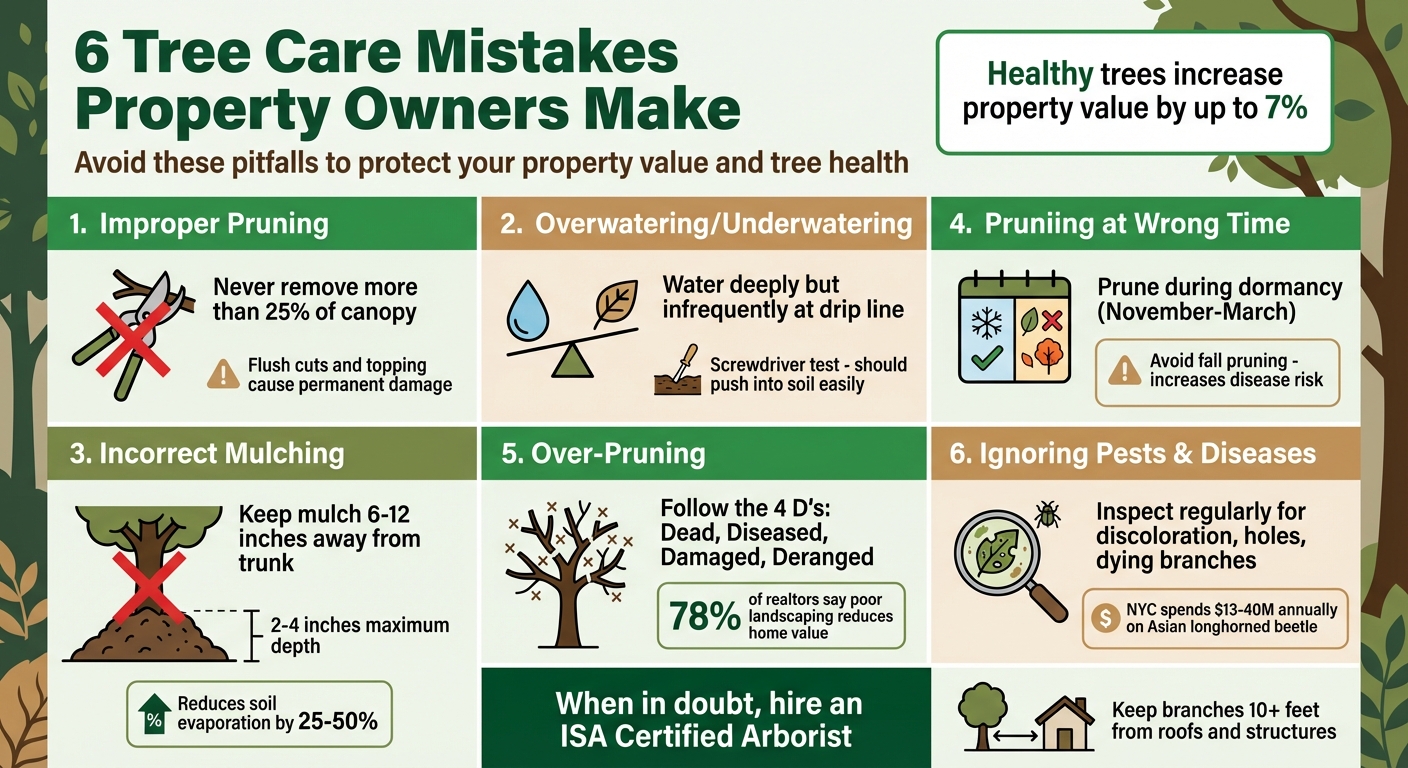
- Improper Pruning: Cutting too much or using the wrong technique can weaken trees, invite decay, and reduce their lifespan. Always prune carefully and hire a certified arborist for large jobs.
- Overwatering/Underwatering: Too much water suffocates roots, while too little causes stress. Water deeply but infrequently, and check soil moisture before watering.
- Incorrect Mulching: Piling mulch against the trunk ("volcano mulching") promotes rot and pests. Keep mulch 6–12 inches away from the base and spread it evenly.
- Pruning at the Wrong Time: Timing matters. Prune during dormancy (winter) for most trees and avoid pruning in fall to prevent disease.
- Over-Pruning: Removing more than 25% of a tree’s canopy can stress or kill it. Only cut dead, diseased, or damaged branches.
- Ignoring Pests and Diseases: Neglecting inspections can lead to infestations or infections. Check trees regularly for unusual signs like discoloration, holes, or dying branches.
Quick Tip: Healthy trees can increase property value by up to 7%, while neglect can lead to costly repairs or removals. Regular care and professional help when needed are the smartest ways to protect your investment.
6 Common Tree Care Mistakes That Damage Property Value
1. Improper Pruning Techniques
Impact on Tree Health
Making the wrong cuts can leave trees vulnerable to serious problems. For example, flush cuts – where the branch collar is removed – can expose the tree to decay-causing fungi and insects. Topping, a practice where the tree’s top is cut off, weakens its structure and leads to fragile watersprout growth that often snaps under stress.
"Topping is a common and harmful trimming technique… This one action can destroy a tree’s structure, health, beauty, value and even take its life." – Karen Cox, WVU Extension Agent
Over-pruning, such as removing more than 25% of a tree’s canopy in one go, significantly reduces its ability to photosynthesize, leaving it stressed. Lion tailing, which strips interior branches and leaves foliage only at the tips, shifts weight outward, increasing the risk of breakage. Additionally, using dull or dirty tools can crush branch tissue and spread diseases between trees.
Potential for Long-Term Damage
The effects of poor pruning don’t just disappear – they compound over time. Topped trees often develop weak, poorly attached watersprouts that are prone to breaking, which can pose safety risks and lead to property damage. Improper cuts, like stub cuts or flush cuts, can prevent wounds from sealing properly, creating an open door for decay-causing fungi. Removing too much foliage also exposes the inner bark to direct sunlight, which can cause sunscald and kill tissue. Over time, these problems can stunt growth, weaken the tree, and reduce its aesthetic and financial value. Understanding these risks highlights why proper pruning is so critical.
Ease of Prevention or Correction
The good news is that these issues are entirely avoidable with the right techniques. Always locate the branch collar – the slightly swollen area where the branch connects to the trunk – and make your cut just outside it. For branches thicker than 1.5 inches, use the three-cut method: start with an undercut, follow with a top cut, and finish with a final cut outside the collar. To prevent spreading disease, disinfect your tools between trees using rubbing alcohol.
Limit pruning to no more than 25% of the canopy at one time, and focus on removing branches that are Dead, Diseased, Damaged, or Deranged (like crossing or rubbing branches). If a tree has already been topped, you can partially correct the damage by pruning weak watersprouts after several months and encouraging growth toward healthy lateral branches. For large trees or work near power lines, it’s safer and smarter to hire an ISA Certified Arborist. These techniques not only prevent issues but also lay the groundwork for healthier, more resilient trees.
Relevance to Property Owners
Pruning done right doesn’t just help your trees – it also protects your investment. Well-maintained trees can increase property value by up to 7%, while topping a large ornamental tree can slash its value by thousands of dollars. Early, proper care avoids expensive fixes down the line. When hiring professionals, get at least three written estimates and ensure the contract clearly specifies the work to be done, such as thinning or cleaning. This ensures your trees receive exactly the care they need to thrive.
sbb-itb-a61c528
2. Overwatering or Underwatering
Impact on Tree Health
Getting watering wrong – whether too much or too little – can seriously harm your trees. Overwatering pushes oxygen out of the soil, choking the roots and setting the stage for root rot, fungal infections, and poor nutrient absorption. Signs of overwatering include yellow or pale-green leaves that drop early (often starting on lower branches) and a soft, gummy texture on tree tissues. You might also spot mushrooms or black mold at the tree’s base.
On the flip side, underwatering leads to drought stress. Leaves may curl, develop brown, crispy edges, and the canopy can appear sparse or "see-through". Trees experiencing water stress also heal wounds more slowly, leaving them open to pests and disease. To check soil moisture, try the screwdriver test: if a screwdriver doesn’t push easily into the soil, it’s too dry. If it slides in and comes out muddy, the soil is overwatered.
These symptoms often hint at deeper issues that could impact the tree’s overall structure and health.
Potential for Long-Term Damage
Overwatering can cause root rot, weakening the tree’s foundation. Blackened, mushy roots can’t anchor the tree properly, increasing the risk of it toppling during storms. Meanwhile, chronic underwatering forces roots to stay shallow, making the tree more vulnerable to wind damage.
"Frequent, light applications of water is one of the most common causes of tree death." – Sarah Browning, Nebraska Extension Educator
Sometimes the damage isn’t immediately obvious. Automatic sprinklers, for example, often water only the top 4 to 6 inches of soil, while trees need moisture to reach 12 to 18 inches for strong, deep roots. This shallow watering encourages weak, surface-level roots, jeopardizing the tree’s long-term stability.
Ease of Prevention or Correction
The good news? Proper watering habits can fix or prevent these issues. Use soaker hoses or drip irrigation to water slowly and deeply at the drip line (the outer edge of the canopy), not directly at the trunk. Early morning watering reduces evaporation and ensures moisture reaches the tree’s feeder roots, ideally 12 to 18 inches below the surface.
To test soil moisture, dig about two inches deep. If the soil feels damp, skip watering; if it’s dry and crumbly, it’s time to water. For established trees, aim for about 10 gallons of water per inch of trunk diameter. Adding a 2- to 4-inch layer of organic mulch around the base (but not touching the trunk) helps regulate soil temperature and retain moisture. Keep in mind that soil type matters: clay soils hold water longer, while sandy soils drain faster and may need watering every 3 to 4 days during hot weather.
"People tend to panic during a drought and think, ‘More water has to be better,’ but that’s not always true – especially with our heavy clay soil… check the soil first. If it still feels damp a couple inches down, skip the watering and let the roots breathe." – Alex Lathrop, Arbor Advisor, Arbor Masters
Adopting these practices can protect your trees and ensure they thrive.
Relevance to Property Owners
Watering correctly isn’t just about keeping trees healthy – it can save you money. Many tree problems stem from improper watering rather than pests or diseases. If you’re unsure whether watering issues are affecting your tree or if secondary problems like root rot have developed, a professional tree health inspection (costing $150 to $550) might be worth considering. For trees under chronic stress, treatments like deep root fertilization or soil amendments can help, but prevention through proper watering remains the most cost-effective approach.
The 5 Biggest Mistakes to Avoid When Caring For Trees
3. Incorrect Mulching
Improper mulching is another common mistake that can seriously harm trees, even when done with good intentions.
Impact on Tree Health
One of the biggest mulching errors is "volcano mulching", where mulch is piled high against the tree trunk. This practice suffocates trees by cutting off oxygen to the roots and disrupting gas exchange through lenticels. When mulch is thicker than 4 inches or touches the trunk, it can stunt root growth – roots begin to struggle when soil oxygen levels drop below 10%. Instead of spreading outward, roots may grow upward into the mulch, leading to "girdling roots" that wrap around the tree and choke its vascular system.
Excessive mulch also creates a breeding ground for fungal diseases, cankers, and pests like carpenter ants and termites. Thick mulch can attract rodents, such as voles and mice, which may burrow into it and chew on the tree’s inner bark, potentially causing severe damage.
"It seems to be fashionable these days for landscapers and homeowners to create these mountainous mulch ‘volcanoes’ at the base of trees. Unfortunately, this continues because there is a lack of knowledge about how trees really grow and the harm caused by this practice." – Vincent Cotrone, Penn State Extension Urban Forester
These issues, while not always immediately fatal, can set the stage for long-term problems.
Potential for Long-Term Damage
Over-mulching rarely kills a tree instantly but can cause a slow decline that may not become obvious for years. Additionally, fresh or uncomposted mulch can temporarily deplete nitrogen in the soil, as bacteria consume nitrogen while breaking down the material.
Ease of Prevention or Correction
The good news? Avoiding mulching mistakes is straightforward. Use organic materials like wood chips or bark, but steer clear of piling mulch against the tree trunk. For young trees, keep mulch at least 6 inches away from the trunk, and for mature trees, maintain an 8- to 12-inch gap to ensure the root flare (where the trunk widens at the base) is visible. Spread the mulch outward to cover the root zone, ideally extending to the tree’s drip line (the edge of the canopy). Before adding new mulch, rake away old, compacted layers to prevent buildup. If you’ve already over-mulched, carefully remove the excess to expose the root flare.
By following these steps, you can protect your trees and help them thrive.
Relevance to Property Owners
When done correctly, mulching offers tremendous benefits. It reduces soil evaporation by 25% to 50%, helps retain moisture, and encourages up to 400% more fine root hair development compared to grass-covered areas. In compacted urban soils, properly mulched trees can produce up to three times more biomass than their unmulched counterparts. Simple adjustments to your mulching habits can save your trees from costly long-term damage while boosting their health and resilience.
4. Pruning at the Wrong Time
Pruning at the right time is crucial – cuts made during the dormant season, like February, encourage healthy growth, while fall pruning can leave trees vulnerable to disease and damage.
Impact on Tree Health
Timing mistakes in pruning can significantly weaken a tree. For instance, pruning during the growing season can attract pests and delay wound healing, making trees more susceptible to infections. On the other hand, pruning between mid-February and early May allows trees to form protective callouses faster, safeguarding them from pathogens.
Pruning also affects flowering. Trees like dogwoods and redbuds, which bloom in spring, develop their flower buds in the fall. Pruning these trees during winter removes those buds, leading to fewer blossoms in spring. Additionally, pruning certain species like maples, birches, and elms too early in spring can cause excessive sap flow, which not only looks unsightly but can also attract stinging insects.
Potential for Long-Term Damage
Pruning in fall comes with its own set of risks. During this season, decay fungi are more active, and tree wounds heal much slower. Pruning within 10 weeks of the first hard frost can also lead to tender new growth that won’t survive the winter. For trees prone to diseases, such as oaks and elms, avoiding pruning from mid-April to mid-October is essential to prevent infections like oak wilt.
"Improper and/or pruning at the wrong time of year may result in poor plant development and reduction in flowering, and may increase susceptibility to insects, diseases, or winter damage." – Clemson University Cooperative Extension Service
Ease of Prevention or Correction
Avoiding these mistakes is straightforward if you know your tree species and its blooming schedule. As a rule of thumb, prune during dormancy (November–March). For trees that flower before June 1, prune right after blooming; for those that flower later, wait until winter or early spring. For species prone to heavy sap flow, hold off pruning until the leaves have fully matured. Following these guidelines ensures healthier trees and a more vibrant landscape.
Relevance to Property Owners
Pruning at the right time not only protects your trees but also preserves your investment in your property. While removing dead, diseased, or broken branches can be done year-round without harm, structural pruning requires careful timing. Homeowners might also consider scheduling professional tree care during fall or winter since services are often more affordable in these off-peak seasons. By syncing your pruning efforts with your tree’s natural cycles, you’ll encourage faster healing, reduce the chances of disease, and keep your landscape looking its best.
5. Over-Pruning
Over-pruning happens when too much foliage is removed from a tree, causing serious harm or even death. The rule of thumb is clear: never trim more than 20-25% of a tree’s foliage in one session. Older trees, in particular, are far less resilient to this kind of stress. Leaves are essential because they produce the energy a tree needs to grow, heal, and defend itself. Removing too many is like cutting off the tree’s food supply.
Impact on Tree Health
Over-pruning puts a tree under immediate stress. Without enough leaves, the tree can’t photosynthesize effectively, leaving it unable to produce the energy it needs to survive. In response, trees often grow weak watersprouts near the cuts. While these shoots are an attempt to replace lost foliage, they are structurally fragile and require constant maintenance.
"Over-pruning shocks the tree by removing a significant portion of its foliage, disrupting its ability to photosynthesize and feed itself. This weakens the tree and makes it more susceptible to diseases, pests, and stressful environmental factors." – Sophia Huang, Certified Arborist, A Plus Tree
Another issue is sunscald, which occurs when too much bark is exposed to direct sunlight. This damages the growth layer beneath the bark. Stressed trees also produce fewer natural defenses, making them more vulnerable to pests and diseases.
Potential for Long-Term Damage
The effects of over-pruning can be long-lasting, even permanent. Aggressive cuts, like those used in topping, leave large wounds that heal slowly and encourage weak, unsafe regrowth. Techniques like lion tailing – removing too many inner branches – make limbs unstable and prone to breaking during storms.
"One too many poor cuts can kill your tree since it creates entry points for wood-decaying fungi to begin rotting your trees from the inside out." – Lydian Pine, Creative Writer
Removing 25-30% of a tree’s canopy in one season can outright kill it by halting its ability to photosynthesize. Even if it survives, the rapid growth of watersprouts creates an ongoing cycle of costly maintenance.
Ease of Prevention or Correction
Avoiding over-pruning is simple: follow the "4 D’s" – only remove branches that are Dead, Diseased, Damaged, or causing Distance issues (rubbing against structures or other branches). Use the right tools for the job: hand pruners for twigs up to 0.5 inches, lopping shears for branches 0.5 to 1.5 inches, and pruning saws for anything larger. Always cut just outside the branch collar to help the tree heal naturally.
If a tree has already been over-pruned, the damage might be permanent. However, you can support its recovery by providing extra water and fertilization. Avoid using tree paints or wound dressings, as they can interfere with the tree’s natural healing process.
Relevance to Property Owners
Over-pruned trees can hurt property values and create safety hazards. Around 78% of real estate professionals report that poor landscaping, including damaged trees, reduces home value. Weak, fast-growing watersprouts are prone to breaking, which can cause property damage, and the need for frequent corrective pruning adds up quickly. For large or complex pruning tasks, hiring an ISA Certified Arborist ensures the job is done correctly, protecting both your property and your trees’ health.
6. Ignoring Pests, Diseases, and Tree Health
Neglecting regular health checks can undo all the care you’ve put into your trees. Skipping these checks allows minor issues to grow into major problems. Believe it or not, insects and diseases destroy more trees in forests than wildfires. And that same risk exists right in your backyard. Since the Asian longhorned beetle first appeared in 1996, New York City and Long Island have spent between $13 million and $40 million annually to manage this single pest.
Impact on Tree Health
Monitoring for pests and diseases is just as important as proper pruning and watering. Trees often give early warning signs if something’s wrong: yellowing leaves (chlorosis), browning edges (scorch), or even premature fall coloring, which can signal root stress or nutrient problems. Look for specific indicators like D-shaped exit holes from Emerald Ash Borer infestations or sawdust-like material (frass) at the base of trees, which points to chewing beetles. Fire blight, a disease that affects over 100 species, creates a distinct "shepherd’s crook" shape in wilted young shoots.
Not all damage comes from pests. Drought or even a run-in with a lawnmower can weaken a tree, leaving it vulnerable to bark beetles or pathogens. Regular checks can help you catch these issues before they spiral out of control.
Potential for Long-Term Damage
Once a disease reaches a tree’s trunk or roots, your options for treatment shrink dramatically. Take fire blight, for example – it can’t be cured. You can only work to contain its spread. Dead branches also pose a serious safety risk. They can snap during storms, damaging property or even injuring someone. And when branches fall, they often tear healthy limbs, creating wounds that invite further infections.
"In the urban forest, insect and disease pests vie with urban sprawl and construction for infamy as the top cause of tree mortality." – Arbor Day Foundation
Ignoring early symptoms can lead to "tree decline", a slow loss of vitality that often ends in death. At that point, you’re not just dealing with the emotional loss of a tree – you could face costly emergency removal and property damage.
Ease of Prevention or Correction
Preventing these issues doesn’t have to be complicated. A simple "walk-around" inspection during the growing season can make a big difference. Check for signs like unusual leaf color or texture and inspect the bark for cankers or holes. Sanitize your tools with 70% isopropyl alcohol between cuts, and avoid over-fertilizing with nitrogen in summer to prevent weak, soft growth. When pruning infected areas, cut at least 6 to 8 inches below the visible damage, and dispose of diseased material by burning or burying it – never compost it. If you’re unsure about what you’re seeing, reach out to your local Cooperative Extension or an ISA Certified Arborist. Many offer free or low-cost assessments.
Relevance to Property Owners
Trees impacted by pests or diseases can threaten both your property’s value and its safety. Overgrown limbs can scrape against rooftops or interfere with utility lines, leading to expensive emergency removals. Keeping branches at least 10 feet away from roofs or siding can help prevent structural damage and keep pests at bay. Planting disease-resistant tree varieties and choosing species suited to your property’s specific conditions (think "Right Tree, Right Place") can save you from future headaches.
Conclusion
Mistakes in tree care don’t just harm the trees – they can also put your property at risk, reduce its value, and lead to expensive fixes down the line. Issues like improper pruning or piling mulch too high around the base of trees (commonly known as "mulch volcanoes") can cause significant damage over time. By the time visible signs like dead branches or leaf discoloration appear, you might already be dealing with costly emergency removals or even structural hazards that could endanger your home and loved ones.
The good news? These problems are avoidable. Keep an eye on your trees during the growing season for any unusual changes, such as discolored leaves or dying branches. Use proper mulching methods, and ensure consistent watering to encourage strong root systems. Neglecting these basics can lower your property’s value and make your investment feel more like a liability than an asset.
"Taking care of trees is essential for their health, longevity, and the overall beauty of our environment. However… these mistakes can have long-lasting and sometimes irreversible consequences for the trees." – Casey Hildebrandt, ISA Certified Arborist
If your trees are near power lines, have large limbs that could pose a threat, or show signs of internal decay, it’s time to call in certified professionals. Viking Tree & Stump provides a full range of tree care services across Oakland and Macomb counties, including 24/7 emergency support for storm-related issues. From routine pruning to stump grinding and detailed health assessments, trained arborists have the expertise and equipment to handle even the most complex tasks safely.
Don’t wait for problems to spiral out of control. Taking a proactive approach not only preserves your trees’ health but also saves you money compared to emergency solutions.
FAQs
How can I tell if my tree is getting too much or too little water?
To figure out if your tree is getting too much or too little water, take a close look at both the soil and the tree itself. Signs of overwatering include soggy soil, yellowing or brittle leaves, fungal growth, or even a bad smell near the tree’s base. Meanwhile, underwatered trees often show dry, crispy, or brown leaves, wilting branches, or they may drop leaves earlier than usual. The soil around these trees will typically feel dry and crumbly.
A quick way to check moisture levels is by inserting a long screwdriver into the soil or digging down about 6–8 inches. If the soil feels cool and moist, your tree is likely getting the right amount of water. Constantly wet soil points to overwatering, while dry, crumbly soil means the tree needs more water. Adjust your watering routine based on these observations to help your tree stay healthy.
What’s the safest way to prune my trees?
To prune trees safely, it’s important to focus on the right techniques, timing, and tools. Pruning should only be done when necessary – like removing dead, diseased, or damaged branches or improving the tree’s structure and safety. Be cautious not to overdo it, as cutting off too much at once can harm the tree.
Choose the right tools for the job. For smaller branches, pruning shears work well, while loppers or saws are better suited for thicker branches. Always aim for clean cuts to prevent tearing or damaging the bark. The ideal time to prune most trees is during their dormant season, typically late winter or early spring. This reduces stress on the tree and lowers the chances of spreading disease.
If the task feels too large or complicated – or if you’re unsure of the correct approach – consider reaching out to a certified arborist. They can handle the job safely and properly.
What is volcano mulching, and why is it bad for trees?
Volcano mulching is the practice of piling mulch into a high mound around the base of a tree, creating a shape that looks like a volcano. While it may appear to offer extra protection, this method can actually harm the tree over time.
When mulch is stacked too high, it traps moisture against the trunk. This constant dampness can lead to bark decay, leaving the tree exposed to pests and diseases. Additionally, the thick layer of mulch restricts oxygen flow to the roots, which can cause root dieback and put unnecessary stress on the tree.
To protect your trees, apply mulch in a flat, even layer about 2–4 inches deep. Be sure to keep the mulch a few inches away from the trunk to allow proper airflow and prevent moisture buildup.