Tree Removal Best Practices in Oakland County, Michigan
A Complete Guide for Homeowners and Property Owners
Oakland County is one of the most densely wooded counties in Southeast Michigan. Drive through Bloomfield Hills, Clarkston, or Milford on any given afternoon, and you’ll pass through canopies of oak, maple, and white pine that define the character of the region. That natural beauty comes with real responsibility — and when a tree needs to come down, how you handle it matters as much as whether you remove it at all.
This guide covers everything a homeowner in Oakland County needs to know about tree removal: when it’s necessary, how to do it safely, what the permitting landscape looks like across the county, and how to make smart decisions about the trees on your property. Whether you’re in Troy, Rochester Hills, Farmington Hills, or out on a rural lot near Holly or Oxford, the principles are the same.
Why Tree Removal Decisions Matter in Oakland County
Oakland County sits in a part of Michigan that transitions between the flat urban sprawl of Southeast Michigan and the rolling, wooded terrain that stretches north toward Flint and Traverse City. The result is a landscape with enormous tree diversity — and enormous tree-related risk, especially during storm season.
The county’s mix of older residential neighborhoods and newer developments means that some trees were planted decades ago and have never been professionally managed, while others were planted too close to homes, utilities, or hardscaping and are now causing structural problems. In cities like Royal Oak, Berkley, and Ferndale — where lots are smaller and trees are dense — a single large tree going down in a windstorm can damage multiple properties at once.
Understanding when a tree needs to come down, and removing it correctly when it does, protects your home, your neighbors, and the broader canopy that makes Oakland County worth living in.
Common Trees in Oakland County and Their Removal Challenges
Before getting into removal practices, it helps to understand what you’re likely dealing with. Oakland County’s tree population is diverse, and different species present different challenges when they need to come down.
Oak Trees
It’s no coincidence the county bears the name it does. White oak, red oak, and bur oak are all prevalent throughout Oakland County, from large wooded lots in West Bloomfield and Orion Township to established street trees in Birmingham and Clawson. Oaks are long-lived and structurally strong, but when they do fail — particularly white oaks that have developed internal decay — they fail in large sections. Removing a mature oak requires careful rigging and directional felling to avoid damage to surrounding structures.
Silver and Red Maple
Maples are among the most commonly planted and most commonly removed trees in Oakland County. Silver maples, in particular, grow fast and are planted everywhere — but their wood is brittle and their root systems are aggressive. In Waterford, Commerce Township, and White Lake, silver maples planted near driveways and foundations decades ago are now causing cracking and root intrusion. Red maples are structurally sounder but still prone to co-dominant stems and included bark, which can split without warning in ice storms.
White Ash
The emerald ash borer has devastated ash tree populations across Michigan, and Oakland County has been hit hard. White ash, green ash, and black ash that were once healthy and beautiful are now dead or dying throughout the county — in Auburn Hills, Lake Orion, Pontiac, and virtually every other municipality. Dead ash trees lose structural integrity quickly and become extremely hazardous within one to two seasons of death. If you have an untreated ash tree on your property, it should be assessed immediately.
Paper Birch and Yellow Birch
Birch trees are common in wetter areas of Oakland County, particularly near lakes and low-lying lots in Walled Lake, Milford, and Highland. They’re beautiful but relatively short-lived, and they’re highly susceptible to bronze birch borer. A birch tree that’s starting to decline will often die from the top down, leaving a structurally weakened trunk long before the whole tree looks obviously dead from the ground.
Eastern White Pine and Spruce
Conifers are popular throughout Oakland County as privacy screens and windbreaks. Eastern white pine and Norway spruce are particularly common on larger lots in Rochester, Clarkston, and Oxford. These trees can grow to enormous size, and when they need to come down near homes or power lines, the removal requires a different approach than deciduous trees — the heavy, dense branching structure from base to crown means there’s no clear trunk to work around.
Cottonwood and Willow
Waterfront properties on Cass Lake, Orchard Lake, Sylvan Lake, and the dozens of other lakes throughout Oakland County are often home to cottonwood and willow trees. Both species are fast-growing, both have invasive root systems that target water and drainage lines, and both are prone to catastrophic failure in storms. Removing a large cottonwood or willow near water requires care to manage the root disturbance without destabilizing the bank.
When Does a Tree Actually Need to Come Down?
Not every tree that looks rough needs to be removed. Oakland County has lost significant canopy over the years, and unnecessary removal is a real problem. But there are clear situations where removal is the right call, and waiting too long creates both safety risks and higher costs.
Signs a Tree Needs to Be Removed
- More than 50% of the tree is dead or dying. A tree that has lost the majority of its canopy has little chance of meaningful recovery and poses an ongoing hazard.
- There is significant trunk decay or hollow sections. Interior rot can exist even when the outer bark looks intact. Mushroom growth at the base, soft wood when probed, or visible cavities all indicate structural failure risk.
- The tree has co-dominant stems with included bark. This is one of the leading causes of catastrophic splitting in silver maples and other fast-growing species. If you can see a tight V-shaped union between two major stems with bark pressed between them, that tree is a ticking clock.
- Root damage or severing has occurred. Construction activity, driveway work, or trenching near a mature tree can kill enough of the root system to destabilize the whole tree within a few growing seasons.
- The tree is leaning over a structure, vehicle, or high-traffic area. A tree that has developed a significant lean toward your home, garage, or driveway needs to be assessed regardless of its apparent health.
- It is dead due to emerald ash borer or other pest/disease. A dead tree loses structural integrity rapidly. Ash trees that were alive two years ago may already be dangerously brittle today.
- The location makes the tree a permanent problem. Some trees were simply planted in the wrong place — too close to foundations, too close to utility lines, or in spots where root growth will cause continuous damage.
When Removal Is NOT the Answer
A few leaves at the end of the season or a single dead limb doesn’t mean a tree needs to come down. Many trees that homeowners consider for removal can be saved with proper pruning, cabling, or treatment. Before committing to removal, get a professional assessment. The cost of a good pruning job is almost always less than the cost of removal and replacement, and a healthy mature tree adds real value to a property in Oakland County.
Tree Removal Permits in Oakland County: What You Need to Know
One of the most common questions homeowners ask is whether they need a permit to remove a tree on their own property. In Oakland County, the answer depends on which municipality you’re in — and in some cases, which part of your lot the tree is on.
It Varies by City and Township
Oakland County does not have a single countywide tree ordinance. Each municipality sets its own rules. Some have strict tree preservation ordinances with permit requirements for removing trees above a certain diameter. Others have no permit requirement at all for trees on private residential property. Here’s a general overview of how the larger communities approach it:
Birmingham: Has a detailed tree preservation ordinance. Removal of significant trees — generally those with a trunk diameter of 6 inches or more at breast height — requires a permit and, in some cases, replacement planting.
Bloomfield Hills: One of the most tree-protective communities in the county. Strict ordinances govern removal, and significant trees on both private and public property are regulated.
Troy: Has a tree preservation ordinance covering trees in certain zones, particularly those affected by development or grading. Residential removal of private trees is generally less regulated.
Royal Oak: Has regulations around street trees and trees on corner lots. Private backyard removal is generally permitted without a formal permit, but street trees require city approval.
Farmington Hills: Regulates tree removal in the context of development and land disturbance. For standard residential removal, permits are typically not required, but you should confirm with the city.
Rochester Hills: Has ordinances in place for development-related tree removal. Individual homeowner removals on established residential lots are generally not subject to permit requirements.
Pontiac: Urban forestry is a significant issue in Pontiac due to tree canopy loss. Street tree removal requires city involvement. Private lot trees are generally not subject to permit requirements.
Milford, Oxford, Holly, and Clarkston: These smaller communities and townships tend to have fewer restrictions on private residential tree removal, though development-related removals may still require permits or site plan review.
The safest approach in any Oakland County community is to contact your city or township’s planning or public works department before removing any large tree. This is especially true if the tree is near the road, if your property is in a historic district, or if you’re also doing any grading or construction work.
Utility and Right-of-Way Trees
Trees that grow in or near the road right-of-way are typically the responsibility of the municipality, not the homeowner — but they’re also not yours to remove without permission. If a street tree is damaged, dead, or causing problems, contact your city’s public works department. In Pontiac, Southfield, Hazel Park, and Madison Heights — where aging street trees are common — the city often has a process for requesting removal or treatment of public trees.
Trees near DTE Energy power lines are a separate matter. DTE has its own tree trimming and removal program for trees that threaten electrical infrastructure. You can contact DTE directly to report a tree that is growing into power lines, but the final call on what gets removed is theirs, not yours.
Tree Removal Best Practices: The Process Done Right
Whether you’re hiring a professional crew or want to understand what proper removal looks like so you can evaluate the work being done on your property, here is what best-practice tree removal looks like from start to finish.
1. Site Assessment Before Any Cuts Are Made
A professional crew should walk the entire site before starting work. This means identifying the target tree’s lean, assessing any decay or structural weaknesses, locating utility lines both overhead and underground, and identifying the safest direction for the tree or sections to fall. It also means looking at what’s around the tree — neighboring structures, fences, landscaping, and other trees that could be affected.
Skipping this step is where most amateur and under-qualified tree removal goes wrong. A tree that looks straightforward from the driveway can have hidden lean, root problems, or proximity issues that completely change the safest approach.
2. Establishing a Drop Zone and Clear Escape Routes
Before any cutting begins, the area where the tree or sections will fall needs to be cleared and defined. In tight suburban settings — which describes most of Oakland County — this is rarely a straight-to-the-ground removal. Homes in Berkley, Oak Park, and Hazel Park, for example, often have trees within feet of the structure, requiring the tree to be removed in sections from the top down.
Escape routes for the crew also need to be established. A feller’s escape route should be at roughly 45 degrees from the intended fall direction, clear of debris and obstructions. This isn’t optional — it’s a fundamental safety requirement.
3. Sectional Removal vs. Straight Felling
In open rural settings — like large lots in Highland, White Lake, or Addison Township — a tree may be felled in one piece if there is sufficient clearance. This is faster and less expensive, but requires precise directional felling using notch cuts and back cuts to guide the fall.
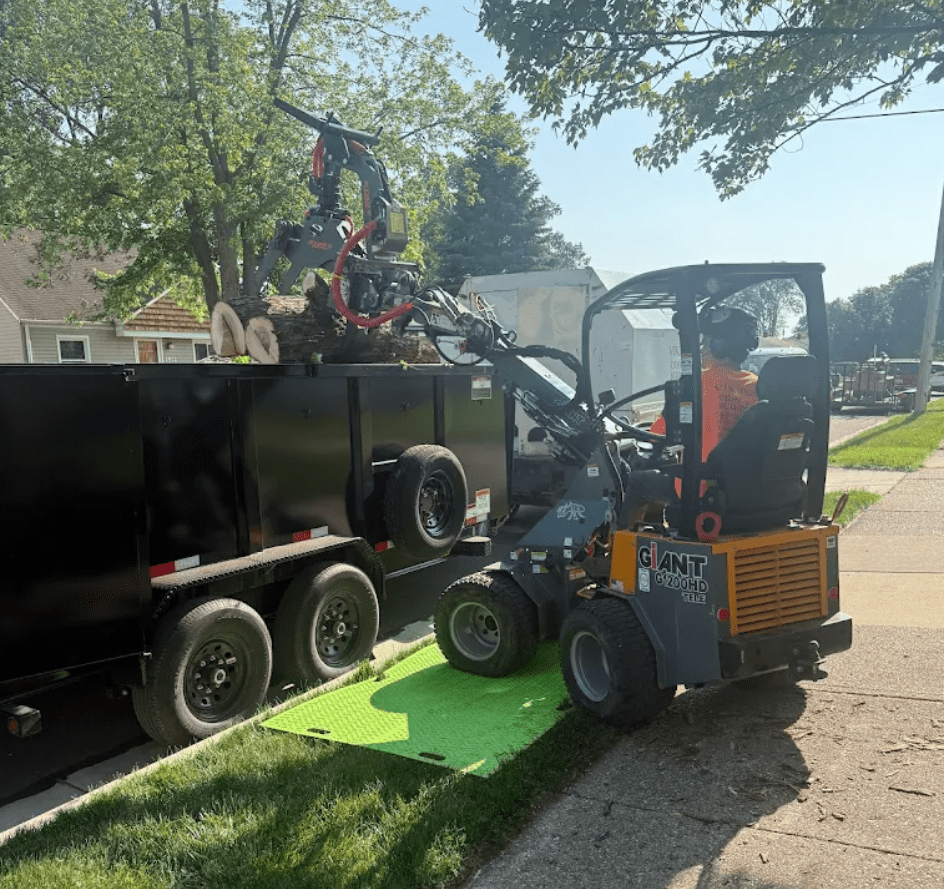
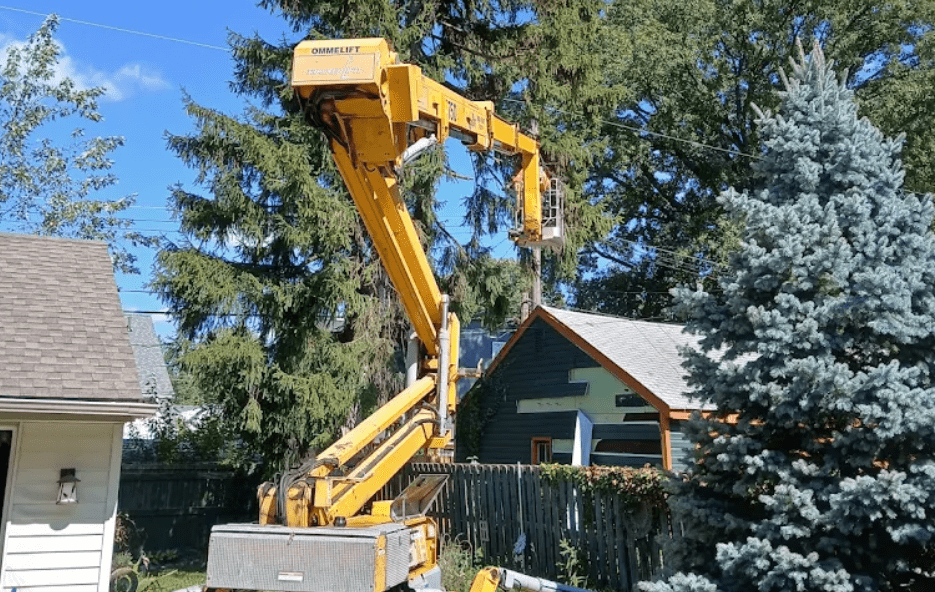
In most Oakland County residential settings, sectional removal is the standard. This means climbing or using aerial equipment to remove the tree from the top down in manageable sections that can be controlled and lowered without damaging the surrounding property. Sectional removal takes longer and requires more skill, but it’s the only appropriate method near structures, power lines, or other trees.
4. Notch Cuts, Back Cuts, and Hinge Wood
For any section of a tree being dropped to the ground, the standard technique involves a directional notch cut on the side facing the intended fall direction and a back cut on the opposite side. The remaining wood between the two cuts — called the hinge — controls the direction of fall. A hinge that is too thin breaks too early and loses directional control. A hinge that is too thick can trap the saw bar.
Getting this right on a large, leaning, or decayed tree is a skill that takes years of experience to develop. It is not something a homeowner with a chainsaw should attempt on a tree anywhere near a structure.
5. Rigging and Lowering Large Sections
When working in confined spaces — between a house and a fence in Rochester Hills, or in a backyard in Wixom with limited equipment access — large limbs and trunk sections need to be rigged and lowered under control rather than simply dropped. This requires ropes, friction devices, and anchor points set in the tree to manage descent speed and direction.
Improper rigging is one of the leading causes of property damage during residential tree removal. A 500-pound section of oak dropping uncontrolled onto a fence or landscaping feature causes far more damage than the cost of doing it right.
6. Stump Removal and Site Cleanup
Once the tree is down and cut, you’re left with a stump. Stumps left in place don’t just look unfinished — they can continue to produce root sprouts for years, especially in oak and maple species, and they can harbor wood-decay fungi and insects. Stump grinding is the standard removal method, taking the stump down several inches below grade so the area can be filled and re-seeded or replanted.
In some cases — particularly with large root systems near driveways or foundations — simply grinding the visible stump isn’t enough. Surface roots may need to be ground out as well, and in cases where the root system has grown into hardscaping, the removal plan needs to account for the disruption.
A clean site means all wood debris, brush, and sawdust are removed or addressed. Some homeowners prefer to keep the wood for firewood — this is fine for most species, though ash trees affected by emerald ash borer should not be transported as firewood, as this spreads the pest.
Hiring a Tree Removal Company in Oakland County: What to Look For
The tree service industry has a low barrier to entry. A truck, a chainsaw, and a willingness to knock on doors is enough to set up shop, which means the quality of companies operating in Oakland County varies enormously. Here’s how to find someone worth hiring.
ISA Certification
The International Society of Arboriculture (ISA) certifies arborists who have demonstrated a baseline level of knowledge about tree care, safety, and best practices. An ISA-certified arborist on staff is a meaningful credential — not a guarantee of quality, but a signal that the company invests in professional development. You can verify certification status on the ISA’s website.
Insurance
This is non-negotiable. Any tree service working on residential property in Oakland County should carry general liability insurance and workers’ compensation coverage. Ask for a certificate of insurance before any work begins, and verify that the policy limits are adequate for the scope of the job. A company without proper insurance puts you on the hook for any property damage or injury that occurs during the work.
Detailed Written Estimates
A professional tree service should be able to walk your property, assess the trees in question, and provide a written estimate that specifies exactly what work will be done, what will be removed from the site, and what the final conditions will look like. Be wary of verbal-only quotes or very vague written estimates. Knowing exactly what’s included prevents disputes after the work is done.
Avoid Storm Chasers and Door-to-Door Solicitations
After major storms — and Oakland County gets its share of them in spring and summer — out-of-area crews flood the region looking for work. Some are legitimate; many are not. If an unfamiliar company knocks on your door the day after a storm offering to remove your damaged tree immediately and at a “special” price, slow down. Verify their credentials, check for local reviews, and don’t sign anything or make a large deposit before you’ve confirmed they are legitimate.
Local Knowledge Matters
A company that operates primarily in Oakland County understands the local tree species, the soil conditions, the typical storm damage patterns, and — importantly — the permit requirements across different municipalities. A company that works regularly in Farmington Hills, Southfield, Troy, and Auburn Hills knows what those cities’ inspectors look for and what their ordinances require. That local knowledge is worth paying for.
Tree Removal After Storm Damage in Oakland County
Storm damage tree removal is a different challenge than planned removal. After a major thunderstorm, tornado, or ice event moves through Oakland County, the conditions on the ground are often chaotic: trees down across roofs and fences, limbs hanging over live power lines, root balls heaved out of saturated soil. The rules of safe removal still apply — they just need to be applied under time pressure and often in compromised conditions.
Prioritizing Safety After a Storm
The first priority after storm damage is identifying immediate hazards. If a tree or limb has come down on or near a power line, treat the line as live and keep everyone away until DTE Energy has been notified and confirmed the line is de-energized. This is not a job for a homeowner or even most tree services — line clearance near energized conductors requires specific training and equipment.
Trees that have fallen on structures create a different challenge. The weight of the tree may be helping to support damaged roofing material, and removing the tree hastily can cause secondary collapse. A professional crew needs to assess the situation before starting any cuts.
Tension Wood and Dangerous Cuts
Storm-fallen trees are almost always under tension or compression in ways that aren’t obvious from looking at them. A tree that fell across a fence is being held at both ends, with its center under tension from below. Cutting into the middle of a tensioned tree without recognizing the stress can cause the saw to bind, the log to roll, or the whole section to spring back violently. Proper technique requires identifying where the stress is, making relief cuts, and working from the outside of the bend inward.
This is one of the most common causes of chainsaw injuries in residential settings, and it’s one of the strongest reasons why homeowners in Waterford, Wixom, Lake Orion, or anywhere else in Oakland County should call a professional after storm damage rather than attempting cleanup themselves.
Don’t Delay Removal of Hanging Limbs
A “widow maker” — a large broken limb that is still suspended in the canopy, held up by other branches or lodged against the trunk — is one of the most dangerous things a storm leaves behind. These limbs can fall without warning days or even weeks after a storm. If you have hanging broken limbs in your trees after a storm, keep people and pets away from the area and get them removed as soon as possible.
Tree Removal and Oakland County’s Urban Canopy
Oakland County has made real investments in maintaining and expanding its urban tree canopy, and many municipalities have active programs to replace removed trees with appropriate plantings. When a tree needs to come down, thinking about what happens next is part of responsible property management.
Replanting After Removal
The best time to plant a replacement tree is shortly after removal, before the site has been disturbed by other activity and while the soil profile is still known. Choosing the right species for the location matters more than most homeowners realize. A replacement silver maple in the same spot where the original caused problems is not an improvement. Consider the mature size of the tree, its proximity to structures and utilities, its tolerance for the site conditions, and its resistance to the pests and diseases that are active in Oakland County.
Native species like bur oak, red oak, hackberry, American linden, and native cherry are well-adapted to Michigan conditions, support local wildlife, and generally require less intervention over time than ornamental species. For smaller residential lots in communities like Madison Heights, Hazel Park, or Clawson, a serviceberry, native redbud, or pagoda dogwood can provide canopy cover and seasonal interest without outgrowing the space.
Community Tree Programs
Several Oakland County communities have tree planting programs or partnerships with nonprofit organizations that can help homeowners access replacement trees at reduced cost. Royal Oak, Birmingham, and Ferndale have historically had active urban forestry programs. Check with your city’s public works or parks department to see what’s available, particularly if you are replacing a street tree or a tree in a visible public area.
Final Thoughts: Getting Tree Removal Right in Oakland County
Tree removal is one of those tasks where the cost of doing it wrong — in property damage, injury risk, or legal exposure — far exceeds the cost of doing it right. Oakland County’s diverse tree population, tight residential lots, active storm season, and patchwork of municipal ordinances all make it a place where professional judgment and proper technique matter.
Whether you’re dealing with a dead ash tree on a Pontiac lot, a silver maple splitting over a driveway in Waterford, a white pine too close to a roofline in Clarkston, or storm damage in Troy or Auburn Hills — the right approach starts with a professional assessment, follows best practices throughout the removal, and ends with a plan for what comes next.
Viking Tree & Stump serves Oakland County with professional tree removal, storm damage cleanup, and stump grinding. If you have a tree that needs to come down, or if storm damage has left hazardous material on your property, contact us for a professional assessment.