Soil compaction is a common problem that can suffocate tree roots, disrupt growth, and shorten tree lifespans. It typically occurs in urban areas due to heavy machinery, foot traffic, or vehicles on unpaved surfaces. Arborists address this issue by diagnosing compacted soil using tools like penetrometers and soil analysis, then applying treatments such as core aeration, radial trenching, or air spade excavation. Preventing compaction, especially during construction, involves protecting root zones and using mulch to maintain soil health. Certified arborists are essential for evaluating and treating soil compaction effectively, ensuring trees have the conditions they need to thrive.
Arborist Soil Compaction Management Process: Identification, Testing, and Treatment Methods
Confronting Soil Compaction Restoring Vitality to Your Trees
sbb-itb-a61c528
How Arborists Identify Soil Compaction
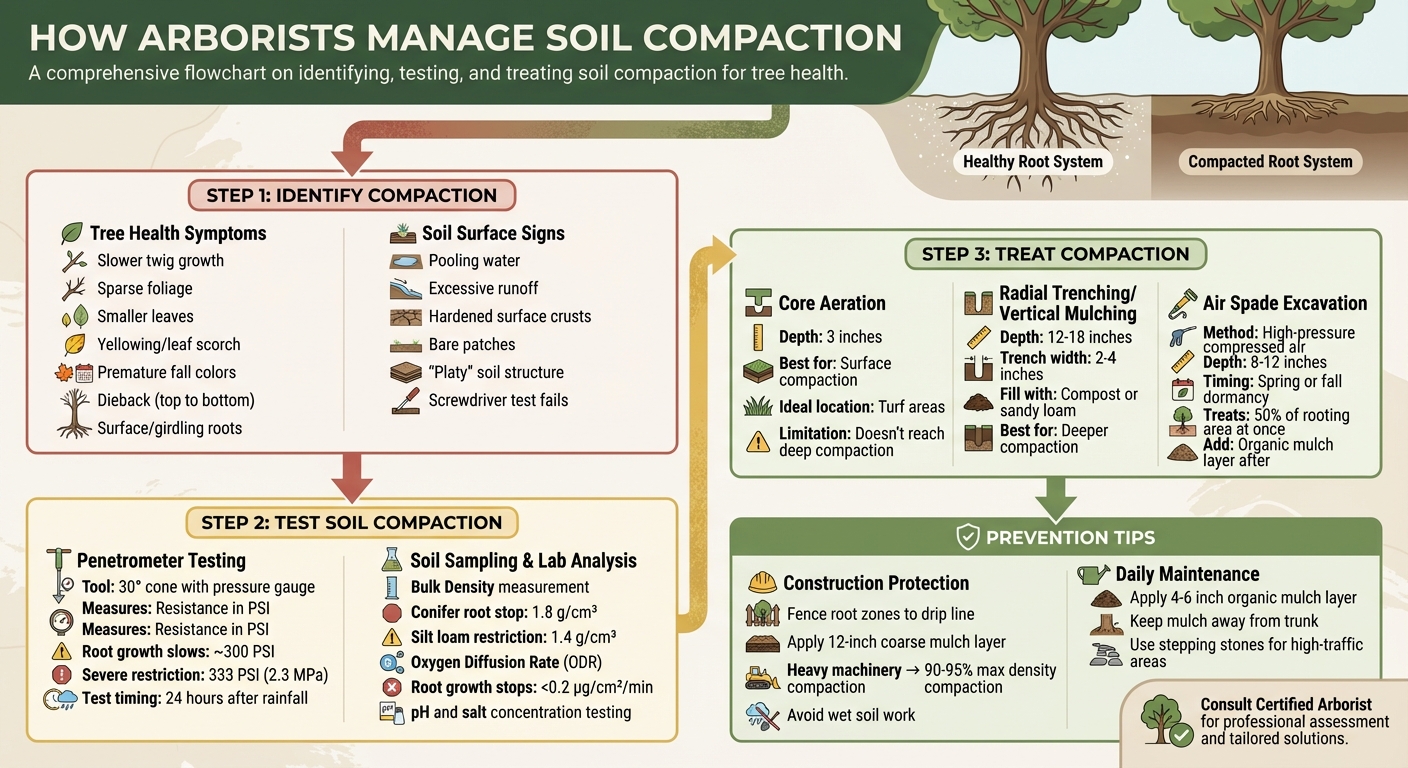
When assessing soil compaction, arborists rely on visual clues from both trees and the surrounding soil. These signs help them determine if root growth is restricted or if oxygen exchange is being blocked. Here’s what they look for:
Tree Health Symptoms
The canopy often reveals the earliest signs of soil compaction. Arborists may spot slower twig growth, sparse foliage, or smaller-than-usual leaves. Additional symptoms like yellowing, leaf scorch, or premature fall colors point to root stress caused by dense, compacted soil.
Dieback is another red flag, typically starting at the top of the tree and moving downward. When roots can’t grow deep into the soil, they spread along the surface or form girdling roots, which can strangle the tree over time.
Soil Surface Signs
Compacted soil often struggles with water absorption, leading to issues like pooling water, excessive runoff, or erosion.
Arborists also look for hardened surface crusts, bare patches of soil from heavy foot or vehicle traffic, and areas where vegetation struggles to grow. A "platy" soil structure – where the soil breaks into flat, horizontal layers rather than loose, crumbly pieces – is another warning sign. If pushing a screwdriver into moist soil requires significant effort, it’s a strong indication that the soil needs professional evaluation. These observations help arborists decide on the best course of action to address the problem.
Testing Methods Arborists Use
When visual signs point to soil compaction, certified arborists rely on specialized tools to confirm the issue and assess its severity. These methods provide the data needed to determine the best course of action.
Penetrometer Testing
A penetrometer is one of the key tools arborists use to measure soil compaction. This device features a 30° cone and a pressure gauge that simulates how a tree root pushes through soil. Arborists insert the penetrometer into the ground at a steady rate of about 1 inch per second, and the gauge measures the resistance in pounds per square inch (psi). This "cone index" reflects the pressure a tree root would need to overcome to grow through the soil.
"The penetrometer is designed to mimic a plant root." – Sjoerd W. Duiker, Ph.D., Professor of Soil Management, Penn State University
Root growth slows significantly when soil resistance reaches around 300 psi, and many woody plants face severe growth restrictions at approximately 333 psi (2.3 MPa). For accurate results, testing should be done 24 hours after rainfall when the soil is at field capacity. The penetrometer’s graduated shaft helps identify the depth of the compacted layer, which is critical for deciding how deep treatments should go. Compared to bulk density measurements, penetrometers often provide more reliable insights because they factor in the relationship between soil texture and moisture.
Soil Sampling and Analysis
To complement penetrometer readings, arborists also perform detailed laboratory analyses of soil samples. These samples, taken in known volumes, allow for the calculation of bulk density – the oven-dry mass of soil divided by the sample’s volume. Bulk density measurements confirm whether reduced pore space is limiting root growth. For example, conifer roots may stop growing entirely at a bulk density of 1.8 g/cm³, while silt loam soils can restrict root development at densities as low as 1.4 g/cm³.
Lab tests also determine soil texture by analyzing the proportions of sand, silt, and clay, which is essential since different soil types compact at varying thresholds. Additionally, these tests measure the Oxygen Diffusion Rate (ODR) – a critical factor for root health. When ODR levels drop below 0.2 μg/cm²/min, root growth halts, and trees experience severe stress. Chemical analyses further identify pH levels and soluble salt concentrations. Compacted soils often accumulate higher levels of road salts due to reduced water movement, which slows the natural leaching process.
The insights gained from these tests play a critical role in shaping effective strategies to address soil compaction.
How Arborists Treat Soil Compaction
Once soil compaction levels are confirmed, arborists apply specific treatments aimed at improving soil health. The method chosen depends on factors like how deep the compaction goes, the tree’s age, and the conditions of the site.
Core Aeration
Core aeration involves removing small, cylindrical plugs of soil – typically about 3 inches deep – to improve surface permeability and create more pore space for air and water infiltration. This method is especially helpful in turf areas around trees because it minimizes damage to both the root systems and the surrounding grass.
That said, core aeration primarily addresses surface-level compaction, leaving deeper layers untouched, where severe compaction might still persist. Overuse of core aerators can also create a compacted layer just beneath the penetration depth. In cases of extremely dense soil, standard aeration equipment may not even break through the surface.
"The core method is the preferred method on turf areas… However, the core penetrates the soil only several inches and does not affect compacted soil below that depth." – Phillip J. Craul, Professor of Soil Science
For deeper compaction issues, arborists turn to other methods.
Radial Trenching and Vertical Mulching
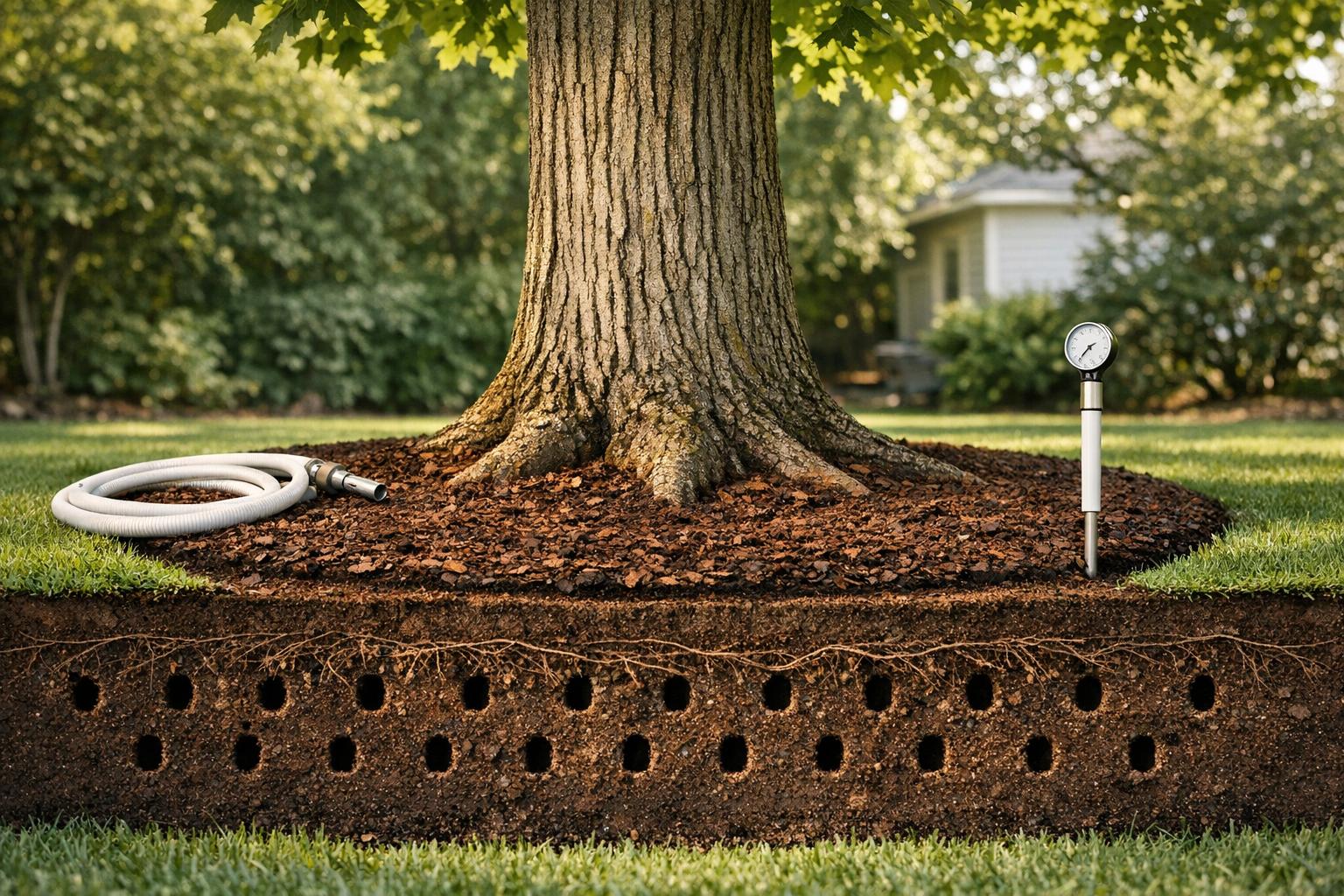
To tackle deeper compaction, arborists often use radial trenching or vertical mulching. These techniques involve digging narrow trenches (12–18 inches deep) or creating grids of small holes (2–4 inches wide) throughout the critical root zone. The compacted soil is replaced with organic amendments like compost or sandy loam, creating channels that allow roots to expand and absorb nutrients more effectively.
A study from the 1990s demonstrated the benefits of radial trenching. ‘Redspire’ Callery pears planted in compacted clay loam showed significantly improved shoot growth within two years when treated with trenches filled with sandy loam. However, the success of these methods depends heavily on soil moisture, as dry, compacted soil is much harder to work with.
"For existing trees and their root systems, radial trenching appears to be a promising technique for compaction amelioration." – Phillip J. Craul, Professor of Soil Science
Air Spade Excavation

When traditional aerators fail to penetrate heavily compacted urban soils, arborists often rely on air spade excavation. This method uses high-pressure compressed air to loosen soil without damaging delicate root hairs. Arborists usually perform this treatment during spring or fall dormancy, targeting the top 8 to 12 inches of soil where fine roots are most active. Once the soil is loosened, organic amendments are mixed in before the soil is replaced.
To ensure the tree remains stable, only about 50% of the rooting area is treated at one time. A layer of organic mulch is then added to help retain moisture and reduce the risk of re-compaction. Beyond addressing compaction, air spade excavation is also a useful tool for safely exposing root systems during health assessments.
"With these tools, a professional can remove compacted soil around tree roots while causing relatively less damage to those roots." – ArborTrue
How to Prevent Soil Compaction
Preventing soil compaction is far easier – and cheaper – than trying to fix it. Once soil becomes compacted, reversing the damage can be both challenging and expensive. By taking proactive steps, you can create an environment that supports healthy root growth and keeps your trees thriving.
Protecting Soil During Construction
Construction work is one of the biggest threats to soil health. Just a few passes of heavy machinery can compress soil to 90–95% of its maximum density. To mitigate this risk, create a soil preservation plan before starting any construction. This plan should outline which areas need protection and which can handle some disturbance.
One effective method is to set up sturdy fencing around tree root zones. The fencing should extend at least to the drip line – the outermost edge of the tree’s canopy – to keep vehicles and foot traffic out of these sensitive areas. For areas that must endure some traffic, applying a 12-inch layer of coarse mulch can help distribute weight and safeguard the soil structure. Studies show that even a 6-inch mulch layer significantly reduces soil compaction caused by heavy machinery, such as a 13,000-pound front-end loader.
"Ideally, tree root zones should be fenced throughout the entire construction process to avoid soil compaction in these sensitive areas." – John M. Lichter and Patricia A. Lindsey, Horticultural Consultants
Avoid using heavy equipment on wet soil whenever possible. Wet conditions make soil particles more prone to compaction because moisture acts as a lubricant, allowing particles to pack tightly together. If machinery use is unavoidable, opt for lighter equipment with wide, low-pressure tires to reduce the impact. Additionally, designate parking and storage areas on spots already planned for driveways or foundations to protect healthy soil.
Using Organic Mulch
For day-to-day soil protection, a 4- to 6-inch layer of coarse organic mulch around trees can work wonders. It helps shield the soil from surface compaction caused by lawnmowers, foot traffic, and light equipment. Mulch acts as a buffer, distributing pressure and reducing the risk of compaction. Over time, as the mulch decomposes, it improves soil structure by boosting organic content and creating pore spaces for better air and water flow.
"Organic matter is the key to creating a well-structured soil. Organic matter acts as a binding agent or the ‘glue’ that holds soil particles together." – Rich Koenig, Extension Soil Specialist, Utah State University
To avoid bark decay, keep mulch a few inches away from the tree trunk. Use coarse materials like wood chips or shredded bark instead of fine mulch, which can limit oxygen flow. If you notice a well-worn path forming on your lawn from repeated foot traffic, consider adding a permanent sidewalk or stepping stones to protect the surrounding soil.
Conclusion: Working with Certified Arborists
Addressing soil compaction isn’t a task for just anyone – it requires a deep understanding of soil science, tree biology, and the right tools to get the job done without causing further harm. Certified arborists bring this expertise to the table, combining their knowledge of tree species and soil conditions with advanced equipment to tackle compaction effectively.
Professionals, like the team at Viking Tree & Stump, utilize cutting-edge diagnostic tools such as penetrometers, nuclear density probes, and air spades. These tools allow arborists to precisely assess soil conditions and treat compaction while minimizing root damage.
As Phillip J. Craul, a Professor of Soil Science at SUNY-College of Environmental Science and Forestry, explains:
"Amelioration of soil compaction under existing vegetative cover, especially trees, is difficult without some injury to the root systems."
Certified arborists take a thoughtful approach to soil compaction. They analyze factors like soil moisture, drainage, and nutrient levels to determine the best course of action. Not every situation calls for aggressive aeration – sometimes, ensuring proper soil moisture is more effective, particularly in sandy loam soils. They also account for the oxygen needs of different tree species and understand that root growth typically stops at around 1.55 Mg/m³ in clay soils but can continue up to 1.75 Mg/m³ in sandy soils. This level of precision highlights the value of professional intervention.
For property owners in Oakland and Macomb counties, Viking Tree & Stump provides the certified expertise needed to diagnose and resolve soil compaction issues. With their help, you can safeguard your trees’ health and protect your landscape investment for years to come.
FAQs
How do I know if soil compaction is affecting my tree’s health?
Soil compaction poses a real threat to your tree’s health by restricting root growth and cutting off access to essential water and nutrients. Look out for signs like stunted growth, wilting leaves, browning or scorching edges, and an overall lack of vigor. Another clue? Water may pool on the surface or run off instead of soaking into the ground.
If the soil feels unusually hard or you struggle to dig into it with a shovel, compaction might be the culprit. This issue is especially common for trees located in high-traffic areas, such as near driveways, sidewalks, or well-trodden paths.
How can soil compaction be prevented during construction projects?
Maintaining soil health during construction takes some thoughtful planning and effort, but it’s absolutely worth it to protect the structure and function of the soil. One simple yet effective approach is to cover the soil surface with materials like mulch or gravel. This helps spread the weight of heavy machinery, reducing the pressure that leads to compaction.
Another important tip: never use machinery on wet soil. Wet soil is much more susceptible to compaction, which can negatively affect water absorption, aeration, and even root growth. Timing matters, so avoid working in these conditions whenever possible.
To further reduce the risk, establish designated pathways and staging areas for equipment. By limiting traffic to specific zones, you can protect more delicate areas of the site. If the soil does get compacted, techniques like aeration or radial trenching can help restore its condition without harming nearby plants.
Ultimately, careful planning and a commitment to minimizing soil disturbance go a long way in keeping the soil healthy and functional during construction.
When should I hire a certified arborist to address soil compaction?
If you’re noticing hard, compacted soil that’s tough to dig into, standing water after it rains, excessive water runoff, or signs of trees struggling with yellowing leaves or stunted growth, it might be time to call in a certified arborist. These symptoms often point to soil compaction, which can block trees from getting the nutrients, water, and oxygen they need to stay healthy.
Certified arborists bring the know-how and tools to evaluate soil conditions and suggest treatments like aeration or soil amendments. Tackling compaction early can help protect your trees and keep your landscape thriving.